
Ahead of trade talks between Indian and United States officials in Delhi, White House trade advisor Peter Navarro said India, which has the 'highest tariffs' of any major country, is 'coming to the table'.

The Indian rupee rebounded against the US dollar after the Reserve Bank of India (RBI) restricted banks' net open positions in dollars. This move prompted banks to sell dollars, providing temporary support for the rupee amidst ongoing geopolitical tensions and rising oil prices.

Putin further described the Ukraine conflict as a mere "pretext" by Western powers to take these broader punitive measures against countries maintaining strong economic ties with Russia.

Uncertainties stemming from the West Asia crisis and its potential impact on inflation and economic growth were key factors in the Reserve Bank of India's Monetary Policy Committee (MPC) decision to maintain the status quo on interest rates, according to the recently released MPC meeting minutes.
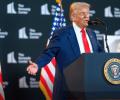
On August 7, the US president announced doubling tariffs on Indian goods to 50 percent for India's purchases of Russian crude oil, but gave a 21-day window to negotiate an agreement.
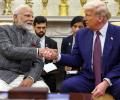
Amidst escalating tensions with Iran, the US has granted India a temporary 30-day waiver to continue purchasing Russian oil, aiming to stabilise global energy markets and encourage future US oil imports by India.

'FPIs are unlikely to return unless there is equilibrium between valuation premium and earnings growth.'

India's pharmaceutical exports have shown robust growth, reaching over USD 28 billion, despite global economic challenges. The sector is projected to reach USD 130 billion by 2030.

Uttar Pradesh's leading export hubs are reeling under the impact of a steep 50 per cent tariff imposed by the US on Indian imports, with exporters warning of job losses, stalled orders and shrinking market access. Industry leaders from Noida, Kanpur and Varanasi said the tariff has put years of painstaking market-building at risk, even as protests and demonstrations erupted in several districts last week.

Indian benchmark equity indices, Sensex and Nifty, snapped a three-day rally, tumbling nearly 1 per cent due to heavy selling in IT stocks, a jump in crude oil prices, foreign fund outflows, and fears of prolonged instability in West Asia.

'The US reciprocal tariff has added another element of uncertainty and the central bank may prefer to wait and get further clarity.'

Tata Steel reported a significant 124.9 per cent year-on-year increase in consolidated net profit to 2,925.74 crore for the fourth quarter of FY26, driven by higher volumes and an improved product mix in India, alongside planned cost reductions across its global operations.

Ukrainian President Volodymyr Zelenskyy has backed the imposition of tariffs on countries maintaining economic ties with Russia, saying it is the 'right idea' in the face of continued aggression by Moscow.

India's micro, small and medium enterprises (MSMEs) - which contribute over 45 per cent to outbound shipments - are facing a major disruption following the United States (US) decision to impose 50 per cent additional tariffs on the country's exports. MSME industry bodies have raised an alarm over the deep impact, seeking immediate government intervention.

Tata Steel, Maruti, Tata Motors, Infosys, Bharti Airtel and Tech Mahindra were also among the laggards. However, Trent, Asian Paints, Hindustan Unilever, ITC, Kotak Mahindra Bank, and Reliance Industries were the gainers.

The additional 25 per cent tariff imposed by US President Donald Trump on India is set to deliver a major blow to West Bengal's export-driven economy, with the state's labour-intensive leather, engineering and marine sectors expecting losses ahead of the festive season, stakeholders said. The increased levies on Indian products for the country's purchases of Russian oil came into effect on Wednesday, bringing the total amount of tariff imposed on New Delhi to 50 per cent.

India should not stay on the margins of this initiative. There should be a serious debate about what would be in India's best interests asserts former foreign secretary Shyam Saran.

The textile and apparel sector is India's second-largest employment provider, after agriculture, and it is now caught in a wave of uncertainty following the Donald Trump administration's tariff policy.

US President Donald Trump's announcement of 25 per cent tariff on all goods coming from India starting August 1, plus an unspecified penalty, is expected to impact Apple's plans to expand iPhone manufacturing in India as well as export of other electronics to the US. The move comes at a time when Indian electronics production is reeling under pressure due to restrictions imposed by China on supply of several critical components, capital goods and even skilled technology professionals.

US President Donald Trump's call to Prime Minister Narendra Modi signals a concerted effort to reset strained Washington-New Delhi ties, with a focus on 'big-ticket' energy and trade deals, including increased Indian imports of US LNG and LPG, and potential cooperation on small modular reactors.

To shield against US President Donald Trump's tariff shock, analysts have been advising investors to focus on stocks of domestic-oriented companies, rather than export-centric ones, to minimise potential losses.

The government on Wednesday put out the draft of a new policy that projects the country's power sector will need Rs 50 trillion in investments by 2032 and Rs 200 trillion by 2047, proposing ambitious reforms in generation, transmission and distribution.

Indian equities on Dalal Street saw volatility. Track Sensex, Nifty50 movement and key market drivers for Feb 25, 2026.

China's ruling Communist Party is holding its annual leadership conclave to discuss the new five-year plan, the impact of US President Donald Trump's tariff war, and the ongoing anti-corruption crackdown in the military.

The Indian rupee depreciated by 52 paise to settle at 93.35 against the US dollar, driven by failed US-Iran peace talks, surging crude oil prices due to a potential US blockade of Iranian ports, and a global flight to the greenback. This geopolitical uncertainty is also leading to foreign capital withdrawal from domestic equities.

If pharmaceutical exports from India to the US come under a 25 per cent tariff bracket, the impact on earnings before interest, tax, depreciation and amortisation (Ebitda) could be around 5 per cent, felt analysts. This is after assuming that about 75 per cent of the tariff would be passed on.

US Treasury Secretary Scott Bessent's remarks come ahead of a high-level summit where India and the European Union are expected to formally announce the conclusion of negotiations on a comprehensive free trade agreement.
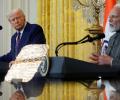
India and the US have entered a new phase in their relationship, marked by greater parity, point out Harsh V Pant and Vivek Mishra.

Commerce Minister Piyush Goyal assures Parliament that India will take necessary steps to protect its national interests following the US announcement of tariffs on Indian goods. The government is assessing the implications and engaging with stakeholders.
Indian benchmark equity indices, Sensex and Nifty, experienced a decline in early trade, ending a three-day rally, primarily due to heavy selling in IT stocks and concerns over prolonged instability in West Asia.
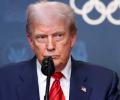
President Trump claims American tariffs imposed on India for purchasing Russian oil have negatively impacted Russia's economy, referring to India as Russia's major oil buyer. He also mentioned plans to meet with Putin and Zelenskyy, and claimed to have solved several wars, including the conflict between India and Pakistan.

China firmly opposes the Trump administration's 50 percent tariffs on India as it is "unfair and unreasonable" and New Delhi and Beijing should scale up economic ties to jointly counter the challenge, Chinese ambassador Xu Feihong said on Monday.

Since February 2025, the RBI has reduced the policy rate by 100 basis points. In its previous policy review in June, it had trimmed the repo rate by 50 basis points to 5.5 per cent.
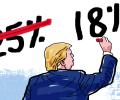
'Trump says India will buy over $500 billion of US goods.' 'At present, India's annual imports of goods and energy from the US are under $50 billion.' 'Reaching $500 billion would likely require more than 20 years, suggesting the figure refers to a long-term aspiration rather than a near-term commitment.'

From the Sensex firms, Bharti Airtel, Tata Motors, Mahindra & Mahindra, Kotak Mahindra Bank, Axis Bank and Reliance Industries were among the laggards. However, NTPC, Titan, Trent, ITC and Bajaj Finserv were the gainers.
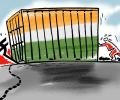
The USA's steep 50 per cent tariffs on Indian goods entering America will severely impact exports and job creation in labour-intensive export sectors such as shrimp, apparel, leather and gems and jewellery. Exporters said that the imposition of a 25 per cent penalty on India over and above the 25 per cent tariffs move will disrupt the flow of Indian goods to its largest export market.
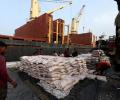
The Federation of Indian Export Organisations (FIEO) has appealed to the Reserve Bank of India (RBI) for liquidity support to Indian exporters, citing a significant increase in freight costs and extended payment cycles due to the ongoing West Asia conflict.

India has completely protected the interests of its agriculture and dairy sector in the India-US trade agreement.

US President Donald Trump has announced a 25 per cent plus tariff on India from Aug 1. Trump, describing India as a "friend", said the US has done relatively "little business" with the country because of its high tariffs.

The 25 per cent US tariffs, plus a penalty for Russian imports, could dent India's GDP growth by 30 basis points in the current fiscal, but the higher duty is unlikely to significantly affect India's domestic demand-driven economy, Barclays said on Thursday. If the 25 per cent tariff, announced by US President Donald Trump on Wednesday, is implemented from August 1, the effective average US import tariff on Indian goods will rise to 20.6 per cent in trade-weighted terms, as per Barclays estimates.
